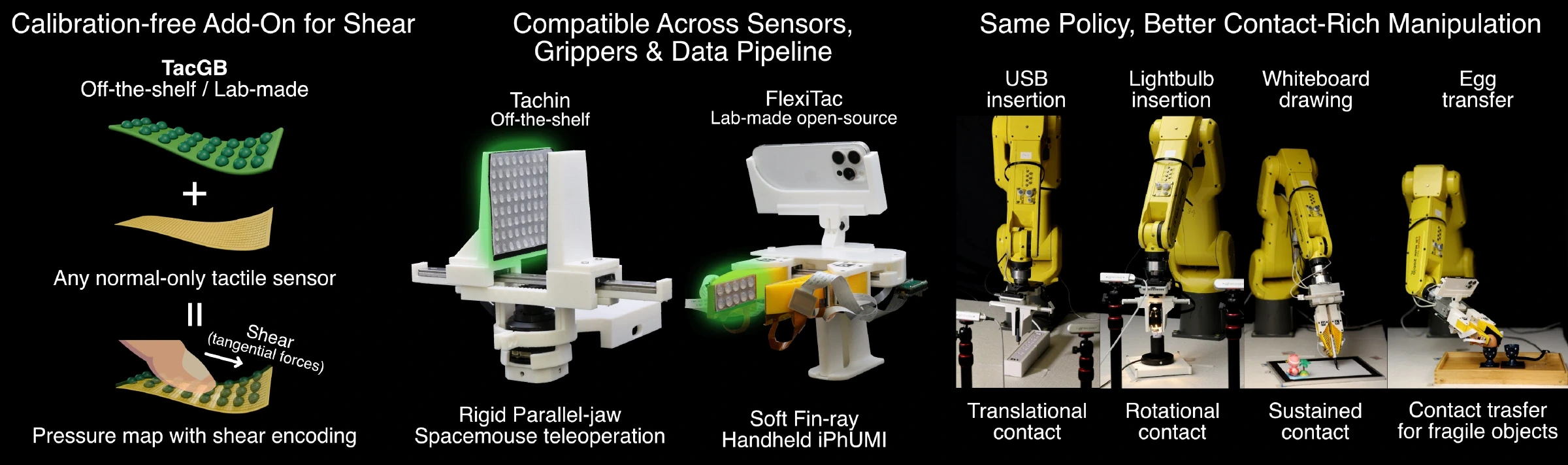
Stick cabinet bumpers onto any existing normal-only tactile sensor. Shear (tangential forces) tilts the domes and redistributes pressure, encoding tangential cues for robot learning.
View full figure +One passive interface principle, evaluated across two tactile sensors and four contact-rich manipulation tasks.
A thin array of soft domes adheres to an existing normal-only tactile sensor.
02
Let mechanics encode shear.
Tangential loading tilts the domes. Pressure increases along the leading side and decreases along the trailing side.
03
Learn directly from pressure.
The policy uses the resulting pressure maps, without reconstructing a calibrated shear-force vector.
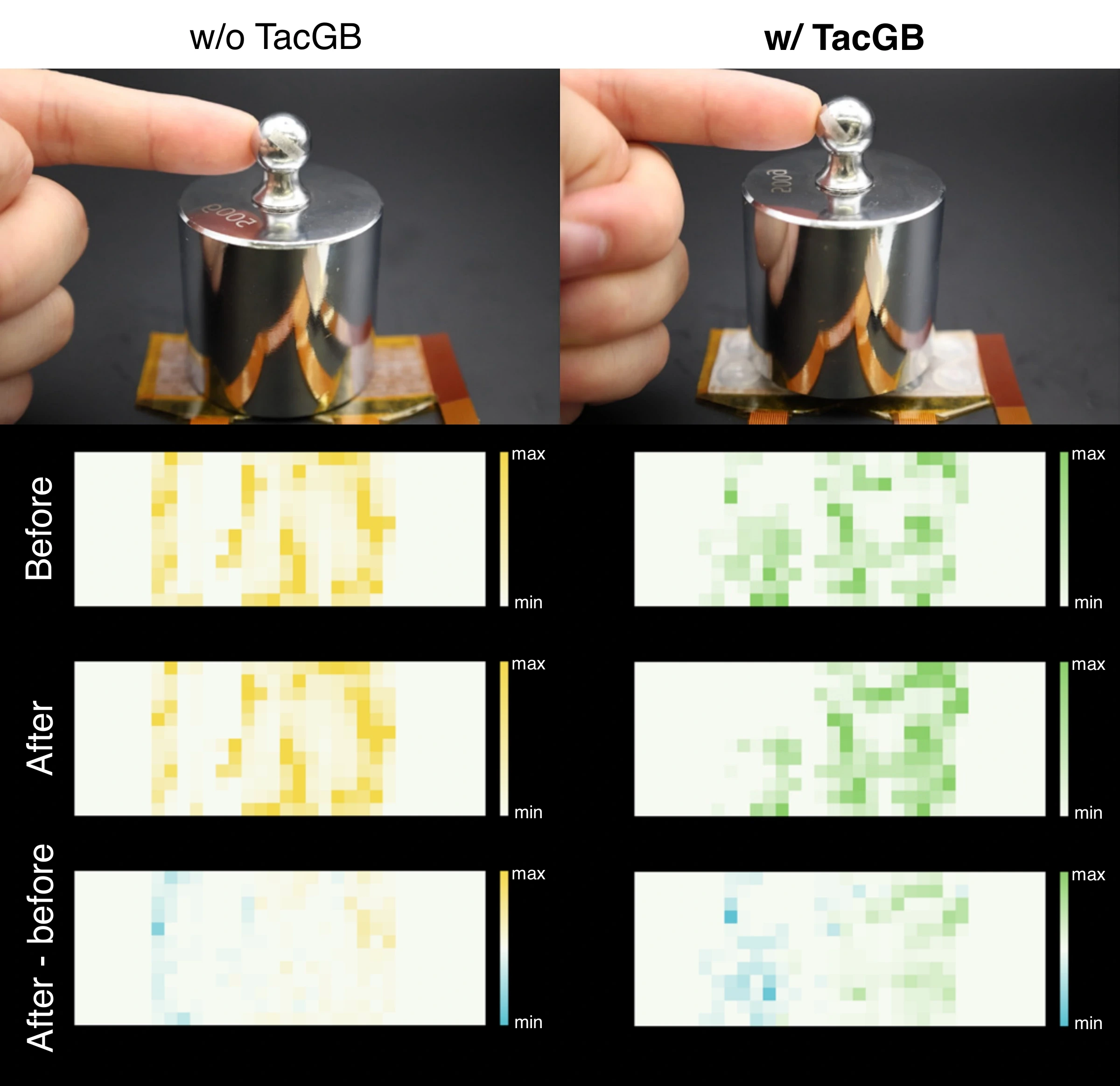
Qualitative static-load demonstration on FlexiTac. A tangential load is applied to a stationary 500 g mass.
Inspect the pressure maps +View full figure +Before/after maps reveal directional redistribution with TacGB.
CUT. ATTACH. LEARN.
An upgrade that starts with cabinet bumpers.
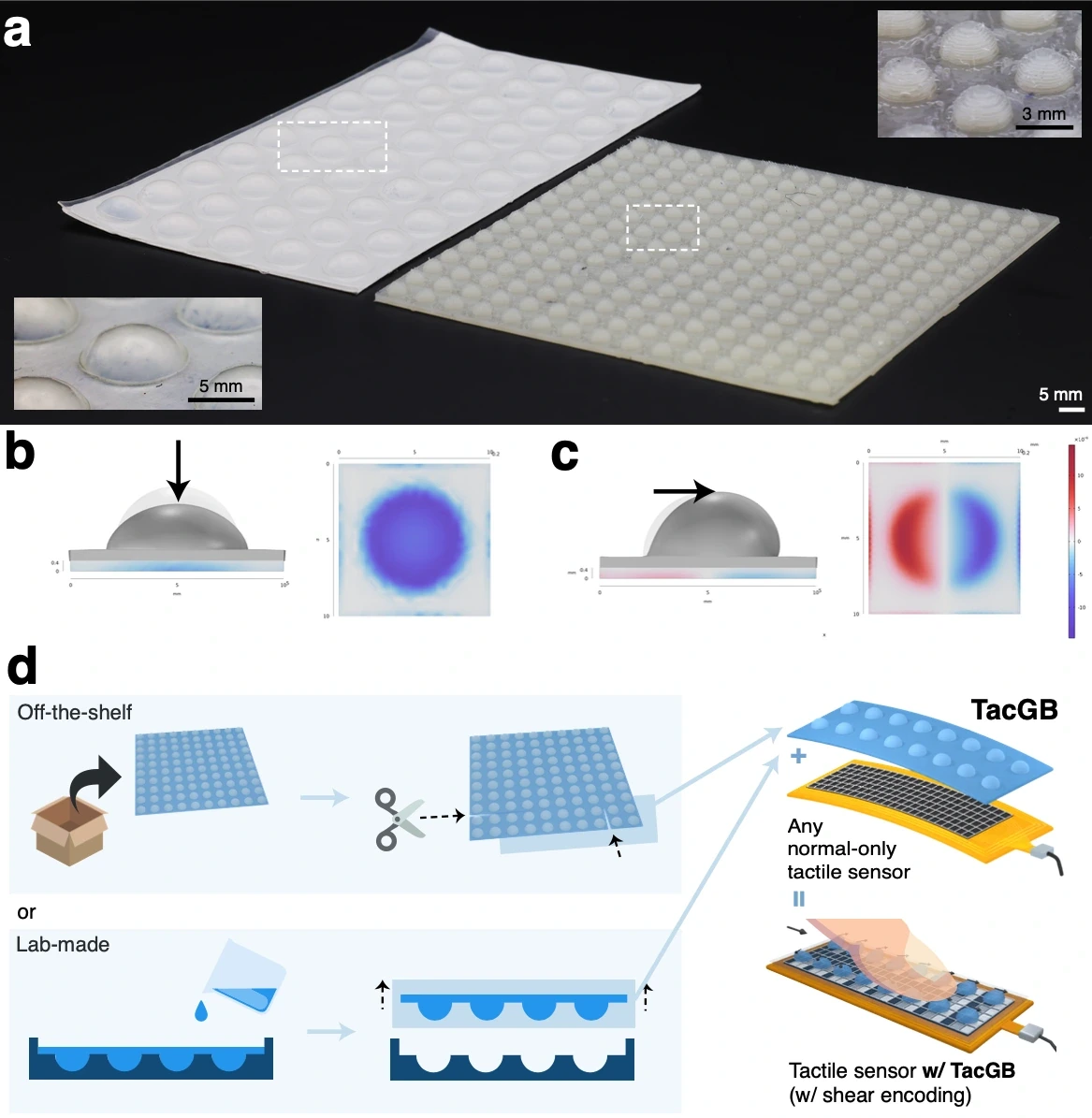
Cut an off-the-shelf sheet to fit, or mold domes for a target geometry. Both versions attach directly to the sensor surface, without modifying its electronics or aligning individual domes to individual taxels.
Integration with commercial capacitive Tachin and open-source piezoresistive FlexiTac sensors.
Explore the design and finite-element analysis +View full figure +Under shear, dome tilt redistributes the normal response. The paper’s finite-element illustration magnifies deformation for visibility.
04 / EXPERIMENTS
Better decisions at the point of contact.
— w/o TacGB— w/ TacGB
Same policy family. Same pressure-map input format. A different mechanical tactile interface.
Representative rollouts · playback speeds are annotated in the video.
Recognize alignment. Know when to stop.
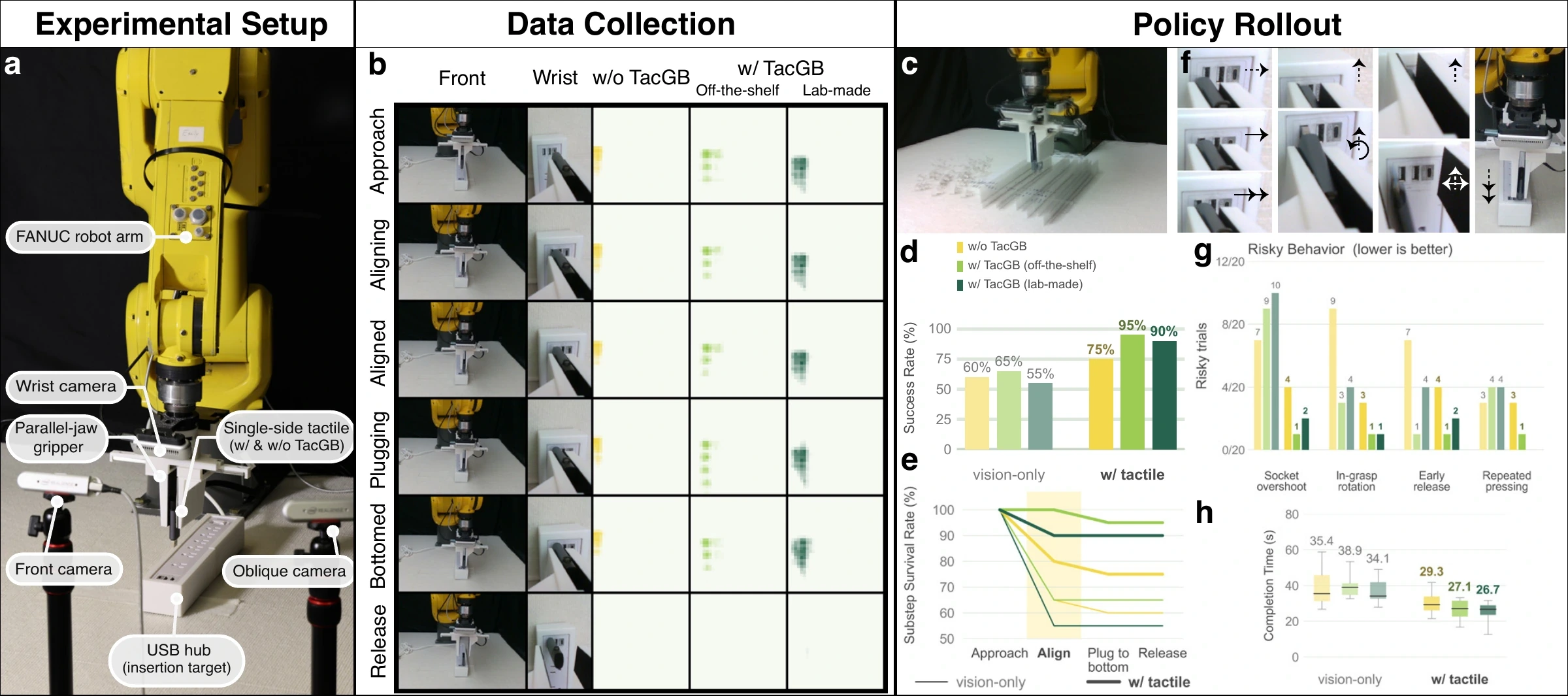
Faceplate contact, socket entry, and full seating can look nearly identical. TacGB makes their load transitions more visible in the tactile input.
95%insertion success
w/o TacGB75%
15 / 20 trials
w/ TacGB95%
19 / 20 trials
Off-the-shelf TacGB. The molded version achieves 18/20 (90%). Mean completion time for successful trials: 29.3 s without TacGB, 27.1 s off-the-shelf, and 26.7 s molded.
View the full USB results +View full figure +USB insertion: all variants are evaluated on the same 20 initial configurations.
Representative rollouts · playback speeds are annotated in the video.
Push. Twist. Then release.
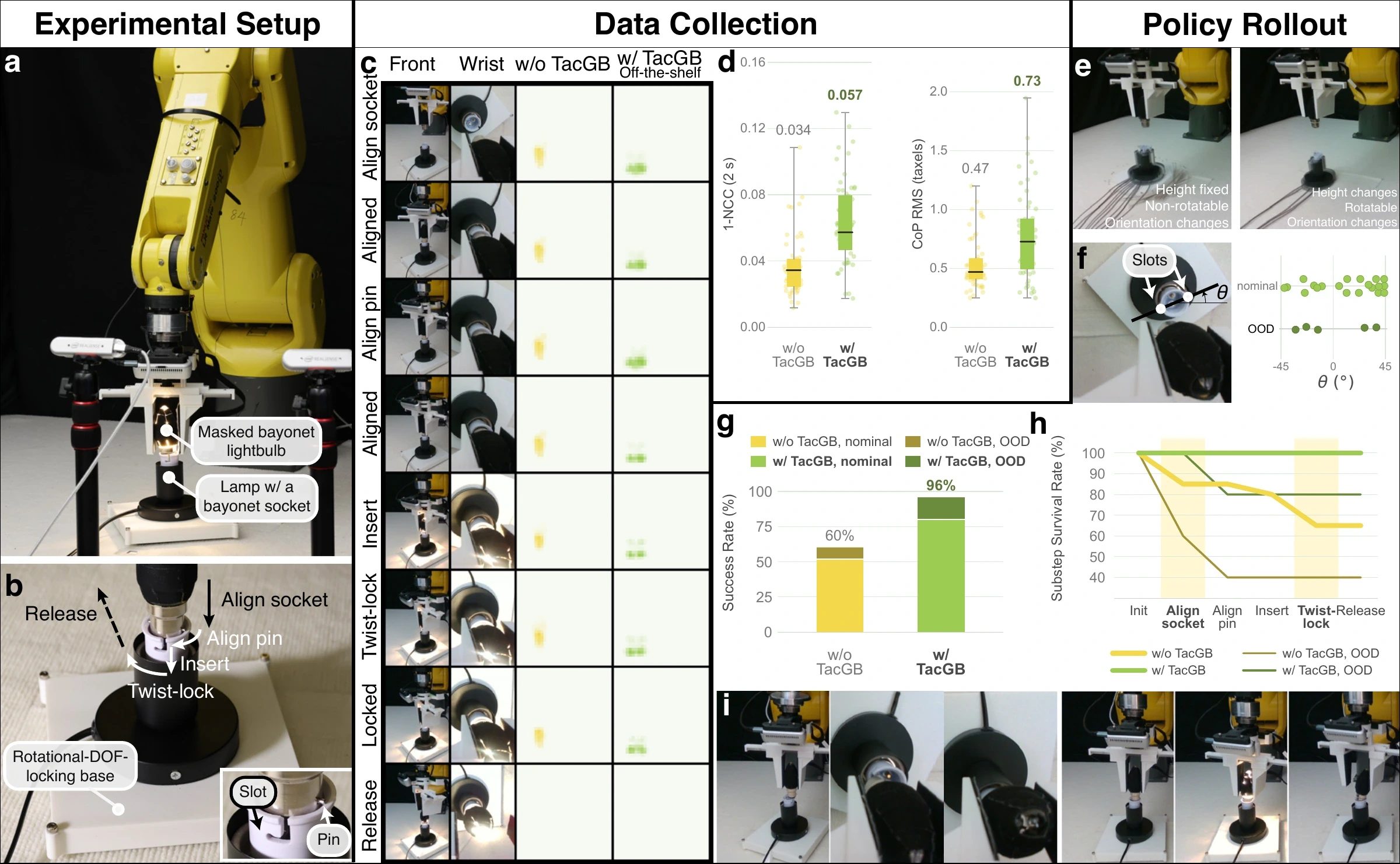
A bayonet lightbulb must be mechanically locked before the gripper lets go. Merely lighting up is not enough: without the twist lock, the bulb springs back out.
96%overall insertion success
w/o TacGB60%
15 / 25 trials
w/ TacGB96%
24 / 25 trials
20 nominal trials plus 5 altered-condition trials per sensing condition. Nominal: 13/20 to 20/20. Altered socket height and free rotation: 2/5 to 4/5.
View the full lightbulb insertion results +View full figure +Lightbulb insertion: gains concentrate around alignment and twist locking.
Representative rollouts · playback speeds are annotated in the video.
Place gently. Release with support.
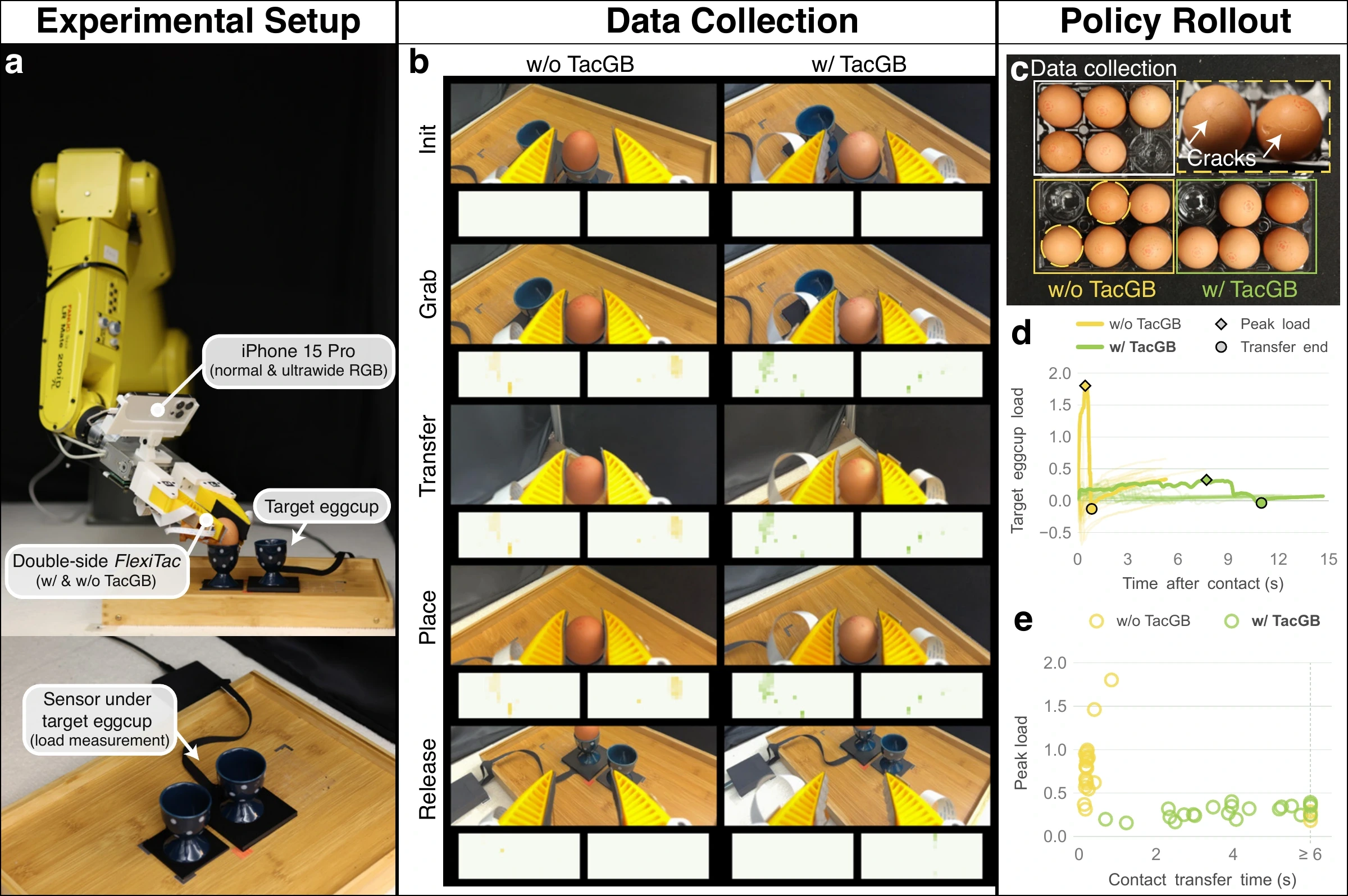
Both policies complete every trial, but binary success hides how the egg lands. TacGB helps the policy transfer support to the cup before release.
−66%mean peak cup-sensor readout
w/o TacGB0.77
mean peak readout
w/ TacGB0.26
mean peak readout
25/25 binary successes in both conditions, using five eggs per condition. Mean contact-transfer duration rises from 0.99 s to 3.84 s.
View the full egg results +View full figure +Egg transfer: lower peak readouts and longer support transfer indicate gentler placement.
Representative rollouts · playback speeds are annotated in the video.
Maintain contact. Stay on the line.
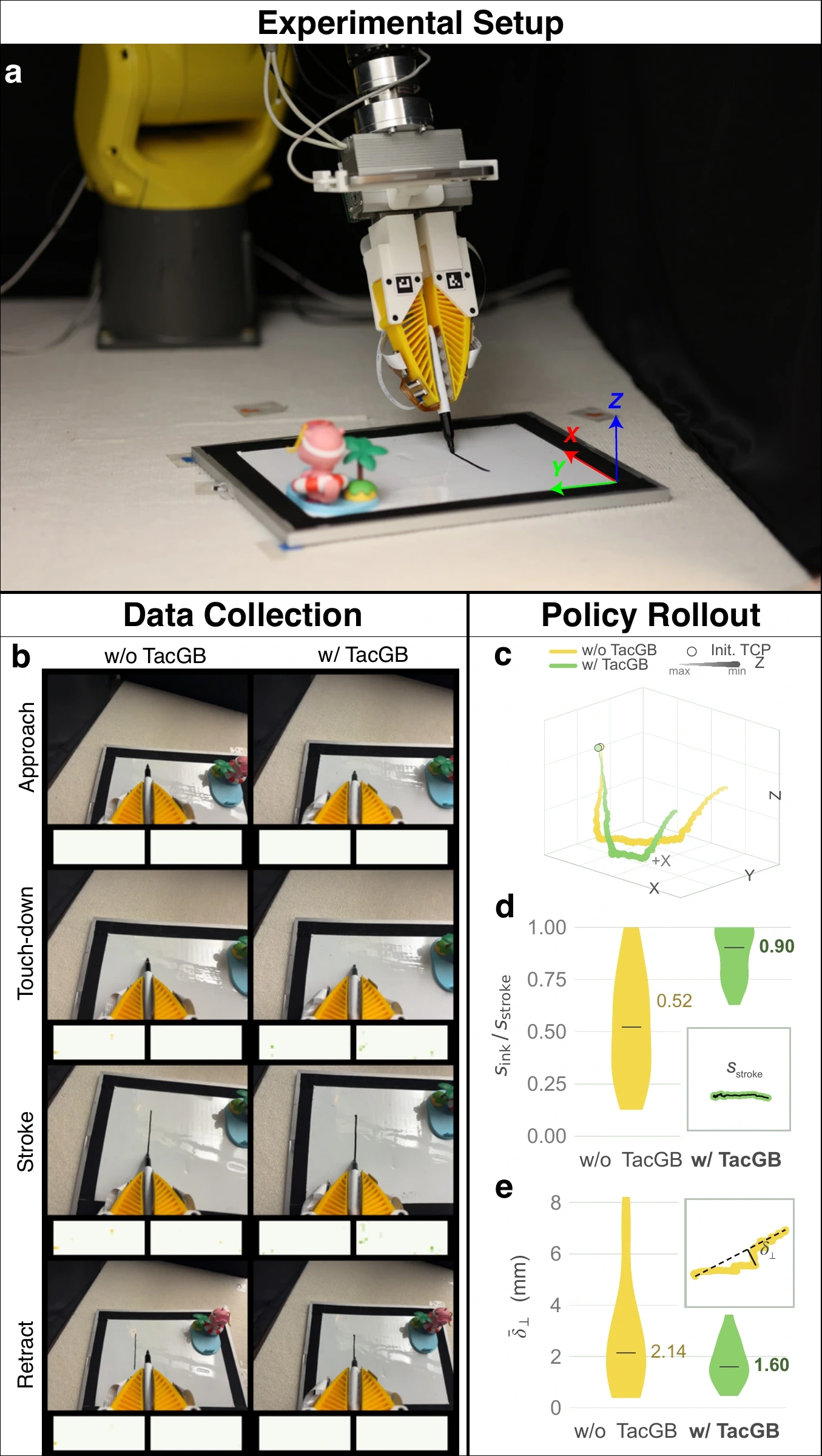
Drawing needs sustained tangential interaction in two directions. TacGB helps keep the marker on the board while reducing lateral wandering.
+66.5%relative ink coverage
−34.5%mean perpendicular deviation
20 rollouts per sensing condition. Coverage is inked length divided by projected stroke length. Straightness is measured by mean perpendicular deviation from the endpoint chord.
View the full drawing results +View full figure +Whiteboard drawing: coverage improves while mean perpendicular deviation decreases by 34.5%.
 TacGB
TacGB